
The long and winding RV road across the USA
The long and winding RV road across the USA
The long and winding RV road across the USA
A photo-journal by Ian Vale
RV DETAILS
There's a whole other world out there, called RV-land...!
It's not since I started offshore cruising in the late 1990s that I've known so little about something major that I was about to undertake.
However, I'll not drag you with me through my research or up the learning curve, on which I continue to travel, but will just present here a few details on the succession of RVs I've used to satisfy my desire to travel the US in a way that closely replicates my previous East Coast/Bahamas/Caribbean sailing (free of timetables, no flight departure times, no checking in and out of hotels, no packing and unpacking of suitcases...).
RV configuration number 1

It's a Winnebago (specifically that brand not generically, as people use the term) and is known as a "Class C" - a motorhome built using a standard van chassis, engine and drivetrain, keeping part of the original driver's cab but adding a custom-built, and wider, body.
This particular RV is built on a Mercedes-Benz "Sprinter" chassis, with its 3-liter, 6-cylinder diesel engine, and the model name is a Winnebago View.
Although compact, the View has a very high specification with a surprising amount of equipment built into it: generator, air conditioning, propane heater, hot water heater, bathroom with separate shower stall, inverter, fridge with separate freezer, two flatscreen TVs (one in the lounge area, one in the bedroom), full entertainment system with Bluetooth and DVD player, roof antenna that picks up local digital broadcasts, two-burner propane stove, twin stainless steel sinks in the galley, microwave with convection oven, LED lighting...

The floorplan can be seen in full by clicking on the thumbnail to the left.
The layout includes two "slideouts", as they are known, which (when parked!) extend the lounge area on the left side and the bedroom section, to the rear, producing a bed which then measures a very generous 75" x 60".
So this fairly compact RV is something of a Dr Who Tardis, a good deal more spacious inside - especially with the slideouts "out" - than it would appear from the external dimensions.
The pictures below should give some idea of how the interior looks, in a clockwise panoramic view from the driver's seat, past the galley, to the bedroom (at the rear) then back past the bathroom to the seating area - click on any of the thumbnails to open a gallery of larger images.


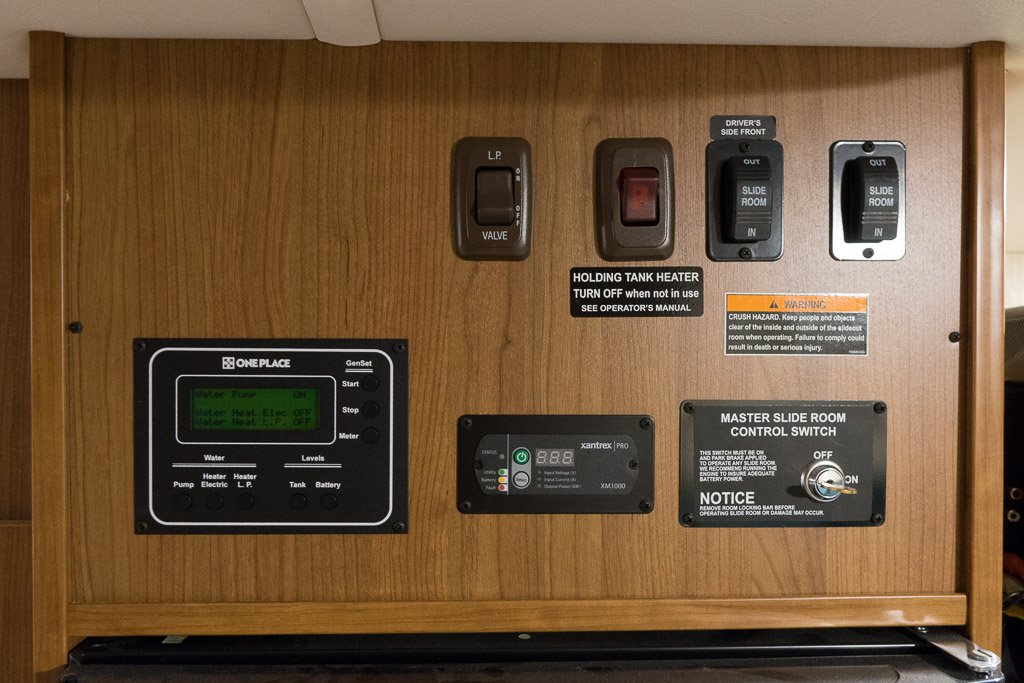


For those people intrigued by such details, the toilet on board empties into what is called a "holding tank" (the black water tank) as do the galley sink and the bathroom sink and shower (into the separate gray water tank). Whenever necessary, these tanks are emptied (dumped, in the jargon) at designated sanitary stations, or dump stations as they are more commonly known, which connect to a standard sewage system.
More than once I've been asked: "What's it like to drive?". Well, it's like a heavy van, which is what it is... But it's an easy drive, not intimidating, reasonable amounts of power and torque from the diesel engine (though no laying down of rubber at the lights...), a good automatic transmission, cruise control, light steering. The brakes are fine, but you're aware they are trying to haul in 11,000lbs of vehicle.
Inevitably the stiff suspension required to handle the weight can give a slightly bumpy ride on rougher roads, especially the rear axle.
Fuel consumption was billed as 16-18mpg (US gallons, which are 4/5 of an Imperial gallon) and that turns out to be fairly accurate. Lots of stop-start town driving or higher speeds can knock it back, but I've had a day of moderate speed highway driving where I've managed 18.8mpg over a 170 mile run.
But enough about the RV. What about the traveling? My first RV trip, from Connecticut to Maryland, starts here.
RV configuration number 2
As you can probably tell from the undercurrent of enthusiasm in the description above, my initial experience with the Winnebago View was very positive.
Even as a complete RV novice, however, I had always known that this first RV - in fact any RV - would present compromises, but a couple of layout aspects of the Winnebago View gradually reached the point where they were detracting from my enjoyment of the RV lifestyle (gradually meaning after tens of thousands of miles on the road):
-
the rear bed, which required making up and breaking down whenever the slideout was extended or retracted, and for which I used more easily managed sleeping bags rather than more comfortable sheets
-
and the seating area, which required the front slideout to be extended and the table leg and table top to be retrieved from storage and set up whenever I wanted to use my laptop other than on my knees (and the process to be reversed again, as with the rear bed, to stow everything before I could drive on)

So enter RV number 2 - a Winnebago Via (rather than "View"), researched extensively on-line and viewed at an RV show before the final, slightly impetuous, purchase at a San Diego Winnebago dealer at the start of 2016 - and designed to very explicitly address these issues.
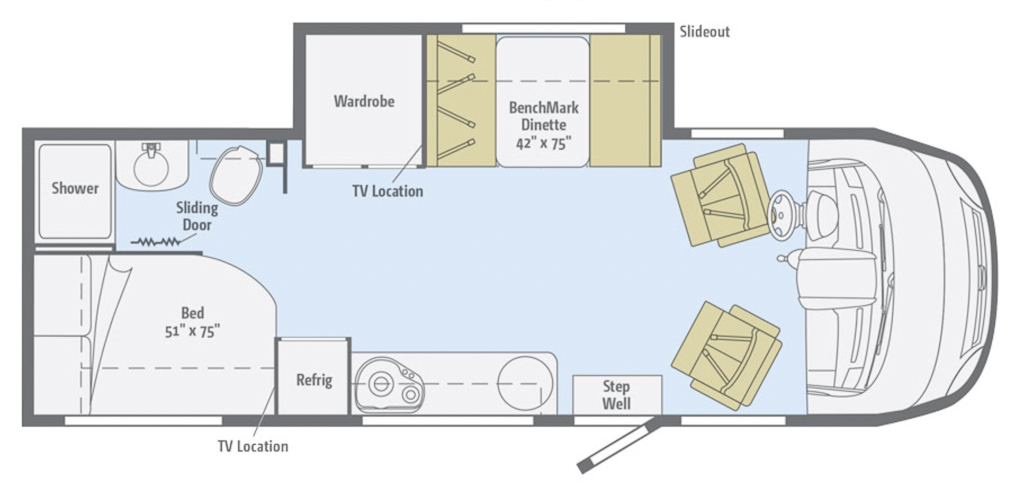
As the floorplan of the Via shows (click to enlarge), there's a fixed bed in the rear right corner and a large dinette table and seating - this section being the single "slideout" on the Via, but the layout worked just fine without needing to extend this and, in practice, I found myself extending the slideout only partially if ever I did.
This new RV - the Winnebago Via - certainly proved the right decision in terms of improved functionality and comfort of the interior layout and, as it was built on an identical chassis, it also shared many of the positive (and less positive) driving and handling aspects of my first RV, the Winnebago View.
However... only having a vehicle restricted to highways means I'm not able to explore beyond the paved road, and many national parks offer trails accessible by cars, or particularly 4x4 vehicles, that would have opened up even more interesting parts of the parks and would have taken me away from the crowds.
RV configuration number 3

My solution - very common in the US, and which I set up in the summer of 2016 when back in Connecticut - was to buy a Jeep Wrangler to tow behind the Winnebago Via, which I could then "unhook" and use to explore beyond the tarmac.
This arrangement also had the advantage that the Winnebago wasn't my sole means of transportation, a huge benefit when back in my office in Connecticut over the summer of 2016 (with the Via permanently parked and simply acting as overnight accommodation).
While the benefits of towing the Jeep Wrangler were tangible, and another a step in the right direction in terms of refining my RV set-up, there were also some penalties... the whole rig was over 40' long; it's not possible to back up at all with a car towed behind an RV (the car wheels snap over to full lock if you try to and the tow bar will get bent); and the combined weight of the RV and Jeep Wrangler mean hard work and slow progress on any kind of incline.
And the general driving issues of the Winnebago - common to both the View and the Via - had not gone away: stiff ride, noise levels, and more...
RV configuration number 4
After leaving Connecticut mid-September 2016 and giving my towing set-up (above) a fairly good test over some 3,000 miles, I concluded I had to make (yet another) change, this time to a "travel trailer" - what might in the UK be called a caravan - even though I was in southern Tennessee, half-way through my intended fall trip down to Florida.
Initially investigating Winnebago and other mainstream "travel trailers" that were compact and fairly light to tow, I found the general build and finish quality difficult to imagine living with - these are the most common "RVs" in the US and as such there's tremendous drive for them to be lightweight and inexpensive, neither attribute designed to produce a high quality product.
But an Airstream is different - still built "old style", by hand, as I had seen in the early summer when I visited the factory in Ohio - so I finally determined this was the solution.
Phone calls to nearby dealers (for which, in US terms, read "within 600-700 miles") identified several of the exact Airstream model I wanted, and so I decided to head 500 miles north to Ohio to an Airstream dealer I had visited in the summer while passing through on my way east.

Arrived there on a Saturday, went over the Airstream in detail and decided it was the right one (light-weight, compact, workable interior layout).
With a price agreed (including trading in my Winnebago Via), I went immediately to a nearby Jeep dealer and found a silver (aesthetically very important!) Jeep Grand Cherokee against which I could trade my Jeep Wrangler - the small Wrangler not up to the task of towing the Airstream.
Decided to hit the pause button briefly and think it all through on the Sunday.

But still feeling good after this brief period of reflection, I committed to both the Airstream and the Jeep on the Monday, got the various financial aspects settled, had everything set up for towing on the Tuesday, and started on the 650 mile drive back east to Connecticut on the Wednesday (for vehicle registration with CT DMV).
After 10 days in Connecticut (for registration and fine-tuning the set-up), I departed for southern latitudes once again, for the second time in a matter of weeks.
Writing this section of this journal now (January 2017) and after some 3,000 miles on the road with the Jeep and Airstream combo I can report that at this point it seems to have been clearly the right decision and the new set-up is proving versatile and comfortable.
However, given my RV-swapping history it may be worth watching this space...
RV configuration number 5
And indeed there has been another modification to my RV configuration, though this one fairly modest compared to earlier ones.
With the Jeep Grand Cherokee approaching 32,000 miles in April 2018 - and therefore nearing the end of the new car warranty - just as I was pausing between trips for a visit back to the UK, I had to decide either to buy an extended the warranty or buy a new tow vehicle.
The Jeep had been plucky, reliable and comfortable, but had to work hard at times to pull the Airstream along, particularly with head-winds or up extended inclines - the 4,000ft non-stop climb out of Death Valley being one of those climbs that immediately comes to mind.
Although I could have "upgraded" to a Jeep Grand Cherokee with a 5.7L Hemi V8 engine (versus the 3.6L V6 I had) or the Dodge version, the Durango, which also had a V8 option and the benefit of a longer wheelbase for better towing and more rear storage, in the end, I figured the best solution - given that 90% of my driving involves towing - was going to be a half-ton truck...
Trucks are made for towing, and the modern iterations are as comfortable and well-equipped as luxury cars.
And never having owned a truck, I thought it was about time...

And why not America's best selling truck for the last 40 years, a Ford F-150...?
And if buying a Ford F-150, why not while was in Texas, the biggest truck market in the USA...?
And that's how I ended up with the latest (for now) configuration of tow vehicle and trailer.
And as an added benefit of the new tow vehicle, the truck is capacious enough to swallow a mountain bike in the rear passenger area (with the rear seats folded up), encouraging me to get into this new, seductive, fun and healthy activity - the introduction and key early guidance generously provided by my very good friend and ex-business partner, Ted Novakowski.
And so the evolution continues...
RV configuration number 6
My configuration of F-150 towing an Airstream worked extremely well while I was traveling extensively... comfortable to drive (the F-150 having all the modern car conveniences and comforts) and the set-up very nimble, the Airstream relatively small and able to be maneuvered into - and out of - tight spaces when necessary.
However... the ratio of traveling to being stationary had been changing, and this particularly so since early 2020 when Covid shut down so many campgrounds in the US.
But even without Covid, my time on the road was reducing, with more time spent either in the UK, 2-3 months over the summer parked in Westbrook, CT, at my old office, and extended amounts of time spent parked at what has become my new US "base" at my friend Les's place, Black Jack Springs, in Texas.
And so the tight confines of the Airstream's interior were becoming increasingly challenging.
The solution was either a larger Airstream - though within the realms of the size I was prepared to tow this would have been only a very partial solution - or a switch to a very different vehicle in the form of a "Class A" motorhome (one where a bare truck chassis is bought and the RV manufacturer builds a complete "box" that is placed on the chassis).
Plenty of desk research led to a favored motorhome (the floor plan being a major consideration) within an "acceptable" quality and price range.

As the Covid pandemic had simultaneously increased demand for RVs and reduced production, only three of the model I was focused on were available in the US in early 2021 - one in California, one in Iowa (where temperatures were below freezing) and one in Florida.
With a good number of RV dealers and the benefit of other, second choice, options to view, Florida won the lottery.
And to cut a longer story short, I drove the F-150 to Florida, traded in the Airstream against a new Winnebago Adventurer 27N, left the F-150 at the dealership, drove the Winnebago back to Texas, flew back to Florida to collect the F-150, and finally traded the F-150 against a new 4-door Jeep Wrangler to tow behind the Winnebago.
When parked with the "slideouts" fully open (see the three "wings" on the layout diagram below), the interior space in the Winnebago is almost more than I need and has a much better traveling office set-up.
And I now have a built-in generator, two A/C units (temperature controlled via thermostats, which the Airstream's single unit wasn't), much greater storage inside and out, walk-around US Queen (UK King) bed, bigger refrigerator and freezer, greater tank capacity, hydraulic leveling system... and the list goes on, as do the pictures:.


A number of aftermarket installations (for anyone interested, list available on request!) have added more convenience, comfort and safety.
But since nothing is perfect, positive attributes in some areas are inevitably offset by negative attributes in others: the new set-up is much less relaxing and comfortable to drive; much more restricted in maneuverability; and rather thirsty on gas - 8 US gallons (10 UK gallons) per mile.
On balance, with increased stationary versus traveling use, it still feels like the right decision to have made.
All I have to do now is adjust my traveling style to better suit the new set-up, essentially driving to a destination via main roads, setting the Winnebago up and using the Jeep to explore locally rather than meandering around and exploring everywhere on a whim and on the hoof with the whole rig as I used to with the F-150 and Airstream.
I guess time will tell if this has been the right move...
RV configuration number 7
My Winnebago Adventurer had served me well in the two years since I bought it in early 2021.
In early 2023 I was, however, facing a decision point... approaching 30,000 miles on the odometer from travels in 2021 and 2022, and with a couple of routine maintenance items needing to be addressed, I felt I had to either invest in another couple of years of ownership or consider a replacement.
Additionally, several specific features lacking in the Winnebago had come to assume increasing importance to me, and this tipped the balance towards a replacement.
After due prioritization of “must-haves” and “nice-to-haves”, and considerable desk research, I had narrowed down the list of acceptable alternative RVs and spent the early days back in the US after my regular February/March trip to the UK hunting down RVs, mainly online (only three candidates viewed “in the flesh” as they were within 250 miles, others typically 1,000 miles or more east, west or north).

After a number of mis-steps I finally bought a 2019 Newmar New Aire from a dealer in Garfield, Minnesota,1250 miles north of my Texas base.
As consignment inventory, however, the dealership wouldn't take my Winnebago in trade. Not wanting either the hassle of selling privately, or the difficulty of synchronizing the Winnebago sale and New Aire purchase, I managed to find a dealer in Florida who (offering a suitably low price!) agreed to buy the Winnebago and send a driver to collect it from me at the dealership in Minnesota.
The New Aire is what, in colloquial terms, could be described as "a proper piece of kit" and represents a significant upgrade in build quality and amenities
Perhaps most clearly illustrated by a couple of numbers: although only 5' longer than the Winnebago (34' versus 29') the New Aire weighs twice as much, tipping the scales at 34,000lbs.

Rather than attempt to list everything here, I've uploaded a copy of the glossy New Aire brochure for the 2019 model year.
Skip down through the fluffy marketing stuff in the first 10 or so pages of the brochure (click on the cover image to open) to see the extensive list of features and equipment that come on the New Aire - and mine has most of the worthwhile options.
While it may appear to be slightly decadent having features such as a washer and dryer and underfloor heating in an RV, this is where I live for most of the year and I've done my time shoveling quarters into washing machines in laundromats in the seedy part of town, and who wants to walk around barefoot on cold tile...


As with anything, there are, of course, trade-offs with the New Aire. It is a wonderfully comfortable place to live but I do feel hostage to a degree to all the systems on board - more stuff to break down, and more complicated and expensive to repair.

And while a pleasure and very easy to drive on major highways - quiet diesel engine at the rear instead of a noisy V8 petrol engine at my feet, air suspension, variable power steering, powerful air brakes, adaptive cruise control - it's a little more intimidating when on smaller roads, not least due to the overall length of 55' when the Jeep is hooked up.
Developing thoughts during 2024... a decision... and a scramble
My "bottom line" (as of early 2024) on the various RV configurations I've had was that the F150/Airstream combination was the best for travel and exploration - comfortable, manageable, flexible and above all "nimble" - but the New Aire is in a different league to all prior combinations in terms of comfort and amenities.
The Winnebago and New Aire motorhomes had forced a change in RVing style when traveling from a freer, fluid, unrestricted and more spontaneous "poking about" approach to more planned itineraries, setting up the RV in a campground and exploring from there in the Jeep, decamping and driving to the next location and repeating.
Although my preference was for the former traveling style, having meandered around most of the US that I want to see, I thought I was reasonably OK with the more targeted and restricted traveling that comes as a package with a motorhome.
But this compromise in traveling style was more emphatically the case with the New Aire, which needed to be plugged into 50amp shore power (or have the generator running) when not being driven whereas previous RVs could quite happily go overnight on battery power.
And the sheer size of the rig going down the road was a constraint in and of itself: the New Aire and Jeep combined weighing 40,000lbs, measuring 55’ long (with the maximum allowable width of 8’ 6”), 12’ 6” high and therefore being somewhat restricted in maneuverability – in particular, the inability to back up with the Jeep attached.
A roadside stranding and subsequent towing when on the way to Albuquerque in May 2024 inevitably produced a residual level of anxiety whenever I hit the road (especially smaller roads with no shoulder onto which I could pull off and where a capable tow truck could be many hours away).
I had plenty of time to ponder all this during a 7-week period of frustration in the fall of 2024 trying to get acceptable new tires fitted to the New Aire (at a cost of $6,000), shuffling around to kill time – and avoid weather – before heading back to Texas, with my potential 2025 itinerary already being dictated by the need to go to the Newmar Factory Service Center in Nappanee, IN, and the Freightliner Service Center in Gaffney, SC, for routine annual maintenance.
Coincidentally, Airstream had recently launched a new model with the kind of specification I would have designed with a clean sheet of paper and a free hand - large Lithium battery bank, 3000W inverter (the two together able to run the air conditioning for several hours without shore power), 500W of solar panels, dual axles and 16" wheels with a 3" lift kit...

A 1,000-mile/3-day drive on boring Interstates back to Texas (after final tire installation in Gaffney, SC) offered further time for mulling things over.
Still pondering once I had parked up at home base, I tried to take recent emotional negatives out of the equation and rationalize the decision-making process (as far as possible) by drawing up a list of concrete pros and cons - click on thumbnail to view.
Having validated my emotional drive to switch back to an Airstream travel trailer with the help of my considered list of pros and cons, I made visits to three Texas Airstream dealers in late November 2024 which led to a year-end scramble to:
finalize a deal on an Airstream
secure the purchase of my New Aire by a wholesaler in Florida (the Airstream dealer not offering a decent trade-in value)...
...which had to be completed before the end of 2024 to hold the agreed price...
...but which couldn't be done until the cracked windshield in the New Aire had been replaced (which couldn't be done by any old Safelite dealer)
find an F-150 with a specific configuration (which had to be done before the end of the December to get year-end deals)
and get a decent trade-in value for my Jeep (complete with its cracked windshield!)
Quite the project... and I just met deadlines with an F-150 deal done on December 27 (although the truck not collected until December 31 after a new windshield was fitted), the deal on the Airstream rescued by the intervention of the dealership's GSM on December 30, and the New Aire collected by the wholesaler's driver on December 31 (complete with new windshield).
One hell of a way to end 2024...
RV configuration number 8

I think the configuration of my New Aire towing my Jeep may have represented, for me, "peak RV".
And now I'm back in an F-150 towing an Airstream travel trailer, essentially trading ultimate comfort for nimbleness and flexibility.

Although similar in many respects to my previous F-150/Airstream set-up with an almost identical floorplan, (though now with twin beds rather than a double bed), 6" wider and 2' longer, the Trade Wind model benefits from a host of welcome "upgrades" due to changes in production methods and as it is higher up the Airstream model range.
But it was the significant differences in the specification of the Trade Wind that made it attractive to me:
a much larger battery bank (Lithium rather than lead acid batteries)
a much larger inverter - 3000W - powering all 110v outlets and which, in combination with the larger battery bank, will actually run the air conditioning for several hours
500W of rooftop solar
twin axles and, as standard, a 3" lift kit (for better ground clearance) and 16" rather than 15" wheels which will take better quality tires (modifications I made to my previous Airstream)
larger propane, water and waste tanks, "on demand" tankless water heater (with a recirculating capability to ensure hot water as soon as a faucet is opened), roof exhaust fans with rain sensors, ducted air conditioning (quieter and better air distribution) with better thermostat control...
Nothing is perfect, of course and one element of the floorplan that remains frustratingly inadequate is the U-shaped dinette - no real usable room on the "long edge" and a very unstable table top supported only by a single, telescoping leg. I've already replaced this with a temporary solution and the Airstream factory service center is due to improve on this further, to my design, with parts from other Airstream models.
And although there is better access to storage (especially with the twin bed layout) the carrying capacity of this particular model is much less than I would like - not just in the specification but lower in my particular build.
Click on the thumbnail below to open the brochure on the Trade Wind model in another tab.

So now I've reached RV configuration number eight. Will there be a number nine...?

Go to top of page